
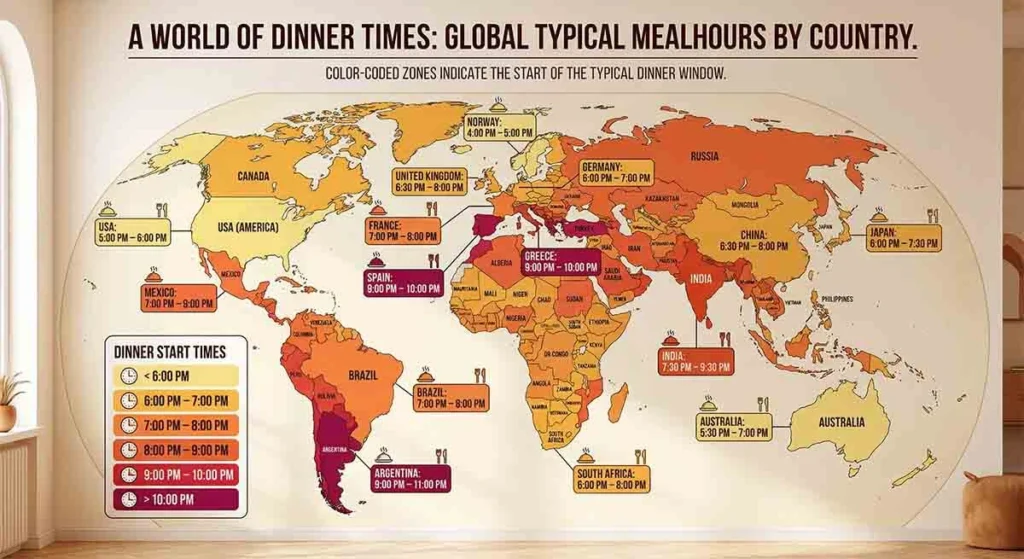
If you’ve eaten dinner with Europeans, you’ve probably noticed the confusion when you suggest eating at 6 PM. In Spain, dinner often starts at 9 or 10 PM. In France, 8 PM is early. In much of Latin America, 8–9 PM is normal. American food culture that eating at 5 or 6 PM seem, to the rest of the world, to be having an extremely early supper.
This isn’t a quirk without cause. The reasons Americans eat when they do are layered — historical, agricultural, industrial, and structural — and most people who follow the pattern have no idea why.
The Agricultural Work Cycle Origin
Pre-industrial America was an agricultural society where work started at dawn and the heaviest labor was completed by midday. The traditional American farm schedule involved: an early light breakfast before dawn labor, a heavy midday meal (“dinner” in traditional American usage) as the main meal of the day, and a lighter supper in the early evening after the afternoon’s work concluded.
This pattern persists in the names: many older Americans and rural communities still call the midday meal “dinner” and the evening meal “supper” — reflecting the original caloric priority. As agricultural patterns shifted, the heavy midday meal moved to the evening, but the early timing followed the agricultural clock that preceded it.
The Industrial Workday Effect
The industrialization of America in the 19th and early 20th centuries created a new schedule driver: the factory and office workday. When work ends at 5 PM, and commute adds 30–60 minutes, dinner at 6–7 PM follows naturally. The entire rhythm of American mealtimes organized around a 9-to-5 work structure that itself emerged from industrial-era labor organization.
European countries, many of which have longer lunch breaks (including a cooked midday meal in some cultures) and later traditional working hours, pushed their dinner timing later by maintaining a larger midday meal that delays evening hunger.
Daylight Saving Time and Its Role
The U.S. adoption of Daylight Saving Time has an indirect but real effect on mealtime patterns. By moving clocks forward in summer, it creates long light evenings that are psychologically associated with “still daytime” — which pushes the perception of dinner time earlier relative to solar time in many regions.
Countries in Mediterranean Europe that eat at 9 PM are often eating at roughly the same solar hour as Americans eating at 6 PM — the clocks just read differently. Time zones and DST create mealtimes that feel culturally different but are sometimes more similar in terms of daylight position than they appear.
The School Schedule Connection
The American school schedule — with lunch served at 10:30 AM–noon in many districts — creates a downstream hunger pattern that drives early dinner for families with children. When a child has eaten lunch at 11:30 AM, they’re genuinely hungry again by 4–5 PM. Family dinner timing often follows the youngest, hungriest person’s schedule, and that schedule is set by school districts whose lunch timing was itself set by operational efficiency rather than nutrition science.
Is Earlier Dinner Better for You?
Chrononutrition research (the study of meal timing in relation to circadian rhythms) has produced interesting findings. Earlier dinner timing relative to bedtime appears to support better metabolic outcomes — the body processes nutrients more efficiently when the digestive system has time to complete its work before sleep hormones kick in.
Eating within 2–3 hours of sleep has been associated with worse blood sugar regulation, disrupted sleep quality, and some evidence of higher cardiovascular risk over time. By this measure, American early dinner timing — if it maintains a 3+ hour gap before a reasonable bedtime — isn’t necessarily the health disadvantage it might seem when compared to the European late-dinner pattern. It depends on what time you go to bed.



Leave a Reply