
“We’re staying together for the kids.” This is one of the most common — and most culturally endorsed — decisions in modern family life. But the research on outcomes for both parents and children when couples stay in unhappy marriages versus divorcing is more nuanced, and in some ways more challenging, than the cultural narrative allows.
What the Research Actually Shows
Multiple longitudinal studies tracking family outcomes over 10–20 year periods have found that parents who divorce from high-conflict or low-satisfaction marriages report significantly higher life satisfaction, better mental health outcomes, and improved physical health outcomes compared to comparable couples who remained in similarly unhappy marriages.
The psychological relief from ending a chronically distressing situation — when that situation is genuinely distressing and not ambivalent — produces measurable, sustained wellbeing improvements. This is not surprising from a psychological standpoint: chronic relationship distress is a significant source of stress-load, and removing it removes the health costs of that stress.
The Effect on Children — What Matters More Than Divorce Status
The research on children’s outcomes is more nuanced than the “divorce hurts children” narrative suggests. Studies consistently find that what matters more for child outcomes than whether parents divorce is:
- The level of conflict children are exposed to
- The quality of the parent-child relationship post-divorce
- Economic stability (which divorce often disrupts, particularly for lower-income families)
- The degree to which children are put in the middle of parental conflict
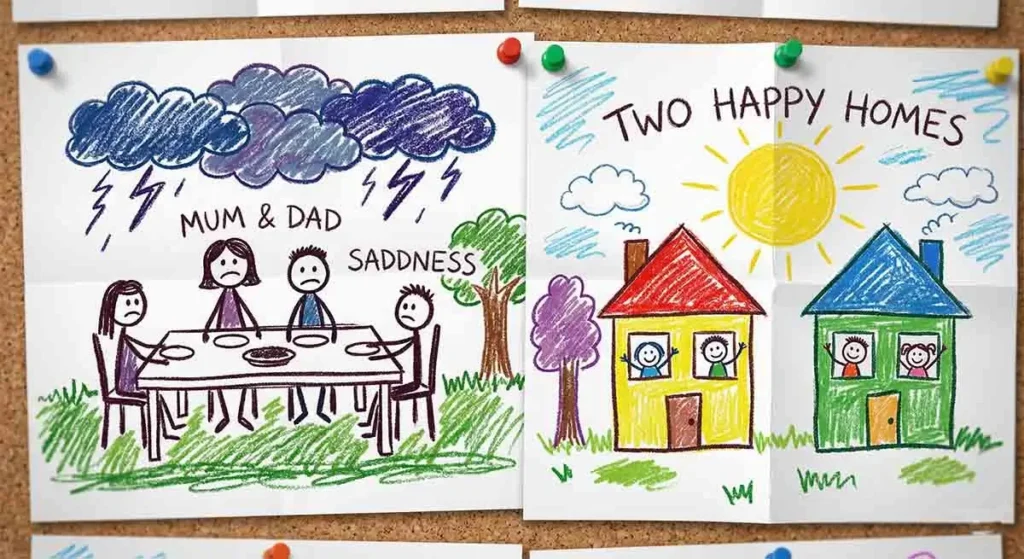
Children in low-conflict divorced families often show better outcomes than children in high-conflict intact families. The “staying together for the kids” decision only protects children when it involves a low-conflict household — which is, by definition, a different situation than most parents mean when they use the phrase.
The Conflict Variable
This is the most important finding: children living with ongoing parental conflict — regardless of whether parents are legally married — show elevated rates of anxiety, depression, behavioral problems, and subsequent relationship difficulties in adulthood. Exposure to chronic parental conflict is a documented Adverse Childhood Experience (ACE) with measurable long-term effects.
A low-conflict divorce (where parents can be functional co-parents without exposing children to ongoing hostility) produces better child outcomes than an intact high-conflict marriage. The evidence on this is robust and consistent across studies.
Parent Wellbeing and Its Effect on Children
Chronically unhappy parents are less emotionally available, more likely to model depression and anxiety, and less able to provide the consistent, attuned parenting that child development research identifies as most protective. A genuinely happier divorced parent who is emotionally present and functional often provides better parenting than a miserable married parent whose distress consumes their available emotional resources.
The Honest Nuance
This research does not argue that divorce is uniformly good or that marriage should be abandoned lightly. It argues specifically against the assumption that staying in a genuinely unhappy, high-conflict marriage is automatically better for children than a well-managed divorce. The two situations are not equivalent — and parents making these decisions deserve accurate information rather than culturally comfortable oversimplification.
Marriages that can improve with work — where the conflict is specific and addressable, where both partners want to repair, where therapeutic intervention is available and hasn’t been tried — are a different category. The research applies specifically to situations that are genuinely unhappy, not ambivalent or repairable.



Leave a Reply