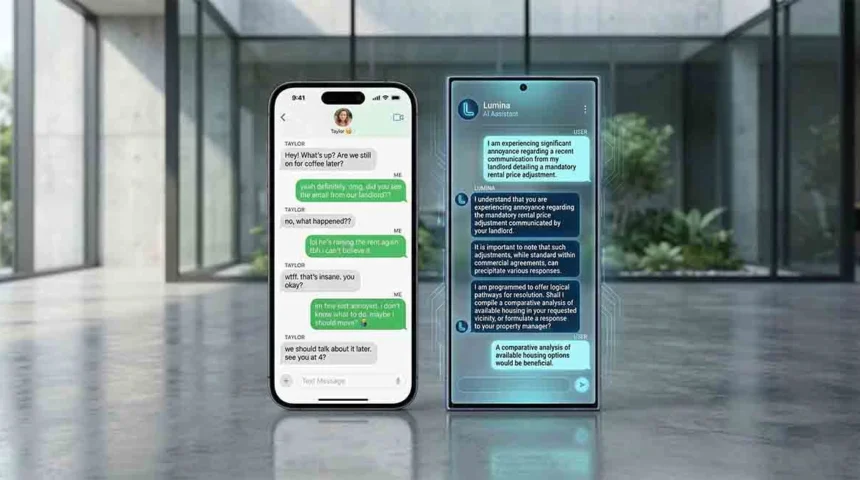
You’re texting someone. The messages are kind, articulate, thorough — but something feels slightly off. They respond too quickly. Every message is perfectly structured. Nobody types like this. Is it possible they’re running your messages through AI and sending the responses?
In 2026, this is not a paranoid question. AI-assisted communication is widespread — in professional settings, in dating apps, and increasingly in everyday personal relationships. Here’s how to identify it and what to make of it when you do.
Linguistic Signs of AI-Generated Text
AI-generated text has consistent stylistic fingerprints, especially when the user hasn’t specifically trained the AI to mimic their voice:
- Unnaturally consistent structure: Messages that always have an opening statement, two to three supporting points, and a closing question feel like AI output — humans don’t naturally write like that in personal texts.
- Zero informal language: No contractions dropped, no “lol,” no trailing off, no grammar mistakes, no autocorrect errors. Real human texts have imperfections.
- Overly diplomatic hedging: Phrases like “That’s a really valid perspective” or “I can certainly understand where you’re coming from” appear constantly in AI responses because they’re trained to acknowledge viewpoints before responding.
- Excessive length for simple exchanges: Responding to “how was your day?” with three detailed paragraphs.
- Specific vocabulary patterns: Words like “certainly,” “absolutely,” “moreover,” “in essence,” “it’s worth noting” appear with suspicious frequency in many AI models’ outputs.
- No tangents or interruptions in thought: Human writing meanders. AI writing is relentlessly focused on the task.
Behavioral Patterns That Suggest AI Assistance
- Suspiciously consistent response times — especially fast for complex questions that would require thought.
- No misunderstandings: Human communication naturally involves misreading, misinterpreting, and getting things wrong. AI rarely misunderstands simple factual information.
- Perfect memory across long conversations: AI tools with memory retain and reference earlier details flawlessly — sometimes in ways that feel unnatural coming from a human who “should” have forgotten.
- No mood variation: If someone’s messages are uniformly helpful and even-tempered regardless of what you share — no frustration, no confusion, no off days — that’s unusual for a real person.
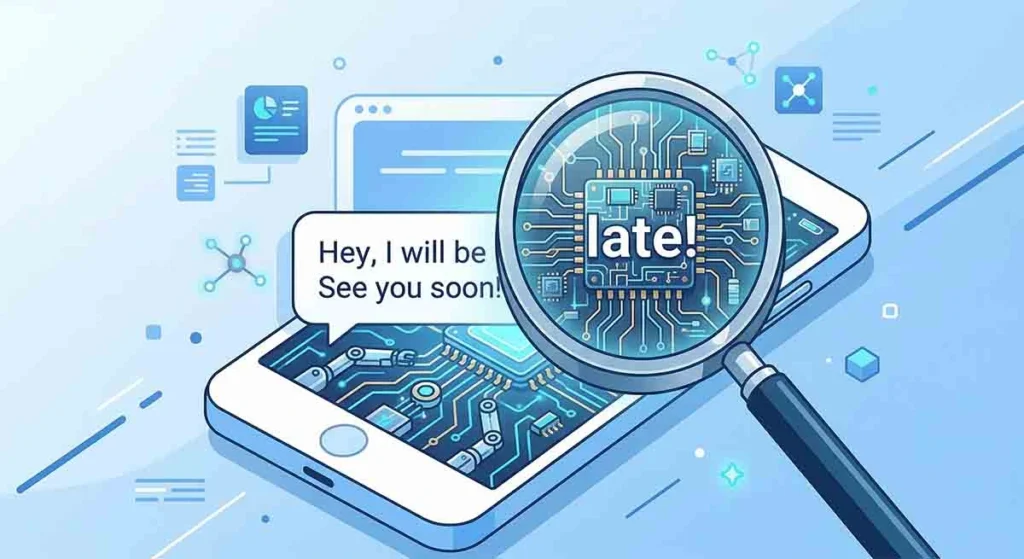
Detection Tools That Actually Help
For longer-form text (emails, letters, notes), several detection tools exist with varying accuracy:
- GPTZero — One of the more established detectors, calibrated for educational and professional use. Works better on longer passages than short texts.
- Originality.ai — More focused on content, less on casual messages.
- Writer.com AI Detector — Free, fast, works on pasted text.
Honest caveat: AI detection tools have meaningful false positive and false negative rates, especially on short texts (under 300 words). They’re best used as one signal among several, not as definitive proof.
Does It Actually Matter?
This depends entirely on context. In a professional context — a contractor, a customer service rep, a job applicant — AI-assisted communication is increasingly normal and arguably neutral. Nobody expects every email to flow purely from the sender’s unassisted mind.
In a personal relationship, the ethics get more complex. If someone is using AI to appear more emotionally articulate than they naturally are, or to manage a relationship they couldn’t maintain with their own effort — that’s a form of misrepresentation. The concern isn’t that AI was used; it’s that the human on the other end is forming a connection with a curated performance rather than a real person.
What to Do If You Suspect It
The most effective test is to introduce genuine complexity. Ask an unpredictable question that requires lived personal experience to answer authentically — something only they would know. AI can approximate answers, but personalness is harder to fake at scale. Ask about something specific and observe whether the response has the texture of actual memory.
If you’re in a relationship context and the concern is real, the direct approach — “I’ve noticed your messages feel really different from how you talk in person” — is more useful than trying to catch someone technically. The conversation you actually need to have is about authenticity and effort, not about software.


Leave a Reply