
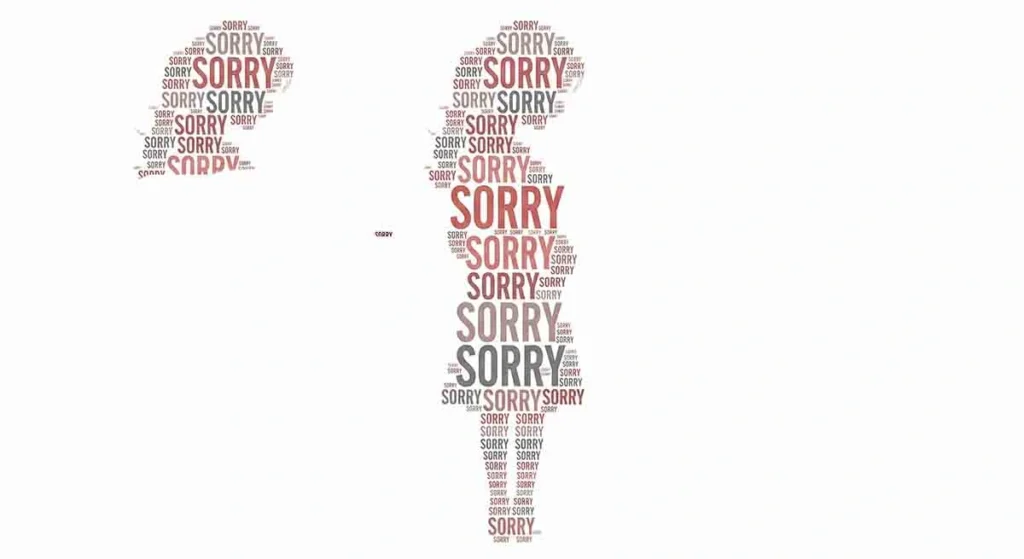
Sorry to bother you — but do you find yourself saying that a lot? Sorry for asking. Sorry, could I just — sorry. Sorry for existing in a space that everyone around you is equally entitled to occupy.
Compulsive apologizing is one of the most common and least examined behavioral patterns in American adults, and it’s almost never about actual wrongdoing. Here’s what’s actually driving it.
Two Types of Apology — Only One Is Healthy
Genuine apology — taking responsibility for a specific harm you caused — is healthy, necessary, and relationship-building. It requires acknowledging what you did, understanding its impact, and committing to do differently. This form of apology has real value.
Reflexive apology — saying sorry as a social reflex, as a preface to existing, as a buffer between yourself and other people’s potential discomfort — is something different entirely. It isn’t about accountability. It’s about managing anxiety and preempting judgment.
Most over-apologizers are engaging in the second type almost exclusively. And the problem is that it looks superficially like the first type, so it often goes unchallenged — even praised as politeness or humility — while the underlying issue goes unaddressed.
Where Over-Apologizing Comes From
The psychological roots tend to cluster in a few consistent patterns:
- Childhood environments where others’ emotions felt like your responsibility. If you grew up around a parent who was volatile, depressed, or unpredictably reactive, you likely learned early that your best tool for managing the environment was preemptive appeasement. Apologizing before anyone was upset. Sorry became a prophylactic.
- Experiences of being “too much.” If you received consistent messages — explicit or implicit — that your needs, feelings, or presence were inconvenient, you internalized that taking up space requires apology.
- Social anxiety. Apology reduces the perceived risk of judgment. Sorry-first positions you as humble rather than potentially threatening.
- Gendered socialization. Research consistently shows that women are socialized more strongly toward preemptive accommodation and verbal appeasement than men — though over-apologizing patterns appear across genders.
What It Costs You
Over-apologizing has real costs beyond the immediate discomfort:
- Credibility erosion. Constant apology signals low confidence, which affects how others perceive your competence, ideas, and authority — regardless of your actual capability.
- It trains people to expect appeasement. If you apologize for every request, people begin to expect deference from you and may react with surprise or irritation when you eventually hold a firm position.
- It prevents resolution. Apologizing reflexively for conflict short-circuits the actual process of working through disagreement. The conflict isn’t resolved; it’s just temporarily suppressed.
- It reinforces the belief that drives it. Every sorry confirms internally that you did indeed need to apologize for existing. The pattern feeds itself.
How to Rewire the Pattern
- Notice before you can change. For one week, count every sorry you say. Don’t try to stop yet — just track. Most people are shocked by the number. Awareness is the prerequisite for change.
- Ask: did I actually do something wrong? Before apologizing, run this quick check. Did your action or words cause a specific harm? If yes, apologize — specifically and genuinely. If no, choose a different response.
- Sit in the discomfort of not apologizing. The first several times you choose not to preface a request or a statement with sorry, it will feel wrong. That feeling is the old pattern asserting itself. It passes.
- Get the underlying belief into therapy. If the pattern is deeply rooted in childhood environment, cognitive behavioral therapy is highly effective at identifying and challenging the core belief that your unmodified presence isn’t acceptable.
Replacement Phrases That Work
Instead of reflexive “sorry,” these direct alternatives cover the same social territory without the self-diminishment:
- “Sorry to interrupt” → “I have a question when you have a moment”
- “Sorry, I don’t understand” → “Can you explain that differently?”
- “Sorry I’m late” → “Thank you for waiting”
- “Sorry, could you help me?” → “Could you help me with something?”
- “Sorry, I disagree” → “I see it differently — here’s why”
These aren’t about being less considerate. They’re about being accurate: directing appreciation to the other person rather than perpetuating the false narrative that your needs require apology.



Leave a Reply