
A household earning $85,000 a year in 2026 is, by historical standards, solidly middle class. They should feel okay. Instead, many of them feel financially squeezed — like they’re working harder than their parents did and have less to show for it. They’re not wrong, and it’s not about avocado toast.
Here’s the structural economic explanation for why the middle-class feeling has shifted so dramatically.
Three Costs That Ate the Middle Class
While overall inflation affects all goods, three specific cost categories have risen far faster than median wages and far faster than general inflation: housing, healthcare, and higher education. Economists call these the “big three” of middle-class financial squeeze.
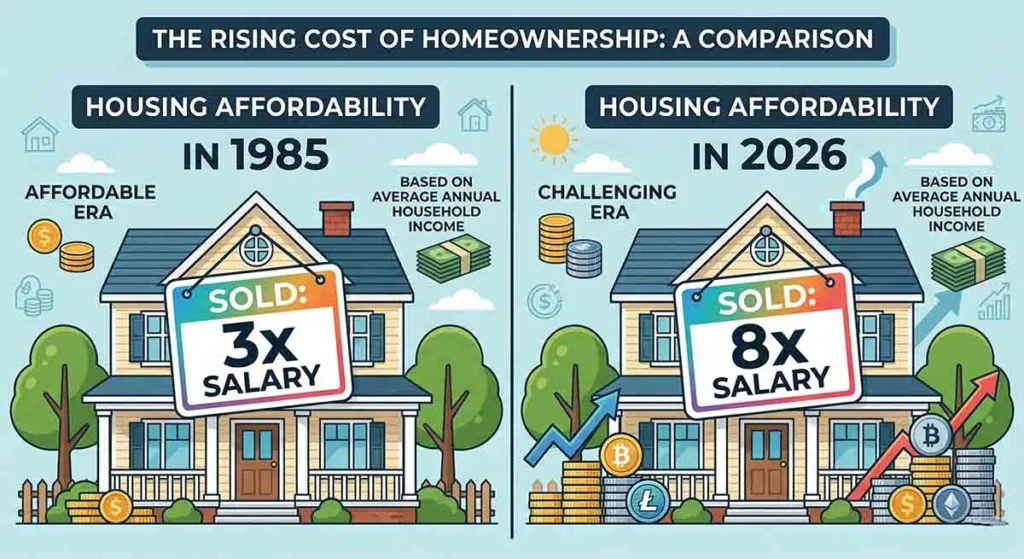
- Housing: Median home prices have increased approximately 400% since 1990, while median household income has increased roughly 140% in the same period (not adjusted for inflation). In 1970, the typical American could buy a home for about 3x their annual income. Today that ratio is 5–7x nationally and 10–15x in many metros.
- Healthcare: Per capita healthcare spending in the U.S. is more than twice the average of comparable wealthy nations, and the portion borne by individuals through premiums, deductibles, and copays has increased substantially even as employer contributions have stayed nominally stable.
- Education: Average tuition at a four-year public university has increased roughly 213% over the last three decades (inflation-adjusted). The credential required for middle-class income now costs dramatically more than it did for the previous generation — often funded by debt that takes decades to service.
The Wage-Productivity Decoupling
From the postwar era through roughly 1970, worker productivity and wages grew together. When workers produced more, they earned more — the gains were broadly shared. Since approximately 1979, this link has broken. Productivity has continued growing; median wages have grown much more slowly. The gains from economic growth have flowed disproportionately to capital ownership and upper-income earners.
In practical terms: the economy as a whole is much larger and more productive than it was in 1975. But the median worker’s share of that growth is smaller than it was — meaning middle-class living standards have improved much less than GDP growth would predict.
Wealth vs. Income — The Hidden Divide
Income inequality gets most of the attention. Wealth inequality is more extreme and more consequential for how “middle class” actually feels. Wealth — assets minus liabilities — determines your cushion against adversity, your ability to absorb the big-three costs above, and ultimately your options.
A household earning $85,000/year with $200,000 in home equity and a 401k has fundamentally different economic security than a household earning $85,000/year with $30,000 in student debt, renting at market rate, and no retirement savings. Both would be described as “middle class” by income. Only one actually feels like it.
What Your Parents Had That You Don’t
- Pensions instead of 401ks: The shift from defined-benefit (employer guarantees a retirement income) to defined-contribution (you bear the investment risk) transferred retirement insecurity from corporations to workers.
- Employer-paid health insurance: The proportion of healthcare costs borne by employees through cost-sharing has increased substantially since the 1980s.
- More accessible homeownership: Lower price-to-income ratios meant home equity accumulation was achievable earlier and more reliably for the middle class.
- Less credentialing inflation: Jobs that paid middle-class wages in 1975 without a college degree now require one — meaning the education cost barrier to middle-class income has risen substantially.
The Honest Outlook and What Helps
The structural issues are real and are not solved by personal finance discipline alone. But within what you can control:
- The most powerful middle-class financial moves today are housing cost management (the biggest single lever), employer-matched retirement contributions (guaranteed return on invested capital), and debt reduction on high-interest obligations.
- Geographic flexibility — willingness to live in lower-cost markets where the income-to-housing ratio is more favorable — is one of the most impactful financial decisions available to middle-class Americans today.
- Building income above the median, through skill development, negotiation, or additional income streams, is more impactful in the current environment than cost-cutting below median.
“The middle class doesn’t feel poor because they’re spending badly. It feels poor because the structural conditions that sustained middle-class living have changed — and the advice hasn’t caught up.”


Leave a Reply