
You decide to put the phone down. For a real reason this time — maybe you’ve noticed you feel worse after scrolling, not better. You set the phone across the room and sit with your thoughts for about 45 seconds before the urge to check it becomes almost physical.
That restlessness, that low-grade anxious itch — that’s withdrawal. And it’s as real as the withdrawal from any other dopamine-loop behavior.
What Is Doomscrolling, Exactly?
Doomscrolling — the compulsive consumption of negative news and content — became a mainstream term during 2020 but the behavior predates it significantly. It’s the act of continuously scrolling through disturbing, anxiety-inducing, or outrage-generating content even when doing so makes you feel worse.
The key word is compulsive. Doomscrolling is not the same as reading the news. It’s the loop — you finish one upsetting story and immediately open three more. You know you should stop. You don’t stop.
The Dopamine Loop That Keeps You Scrolling
Dopamine is not the “pleasure chemical” it’s often described as. More accurately, it’s an anticipation chemical. It spikes in response to the possibility of reward — not the reward itself.
Social media feeds are built on variable reward schedules — the same mechanism that makes slot machines addictive. You scroll, and you might find something interesting, funny, infuriating, or validating. You can’t predict which it will be or when. This unpredictability is precisely what makes the dopamine system go into overdrive.
Every scroll is a pull of the lever. Your brain, wired by millions of years of evolution to seek out novel information (it was survival-critical once), cannot easily distinguish between “scan the horizon for predators” and “check Twitter.” Both trigger the same ancient seek circuit.
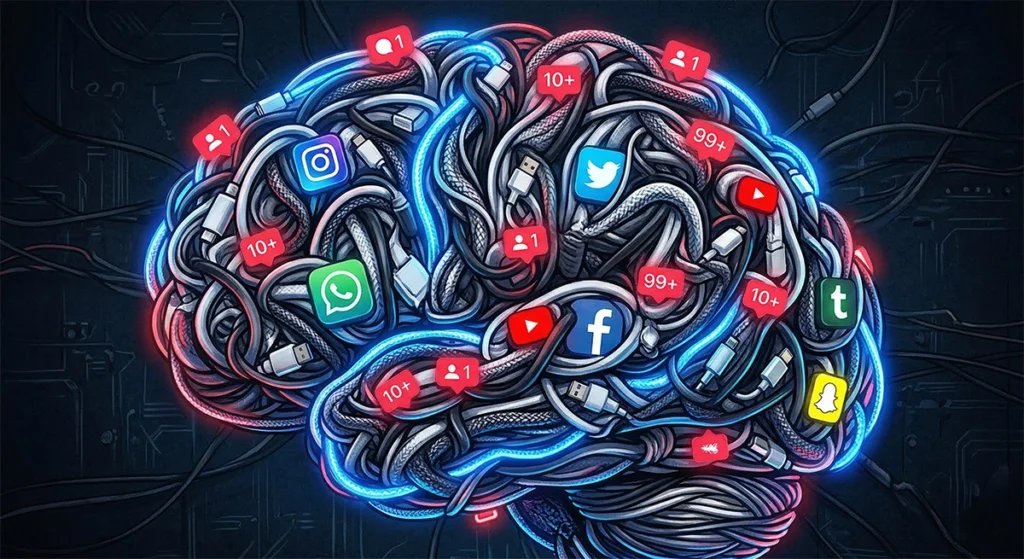
Real Withdrawal Symptoms You Might Be Experiencing
If you’ve tried to significantly reduce your social media use and found it harder than expected, you may have experienced some of these:
- Phantom phone checking — Reaching for your phone before you’ve consciously decided to, multiple times per hour.
- Restlessness and inability to focus — A scattered feeling, like your attention doesn’t know where to land.
- Increased anxiety about missing information — A nagging sense that something important is happening and you’re not seeing it.
- Boredom that feels almost painful — A low-stimulation environment suddenly feels unbearable in a way it never used to.
- Irritability in the first 24–48 hours — Snapping at people, difficulty tolerating slow moments.
- Vivid dreams about scrolling — Some people report dreaming about feeds during digital detox periods.
These are not dramatic. But they’re real. And they’re the same category of symptoms — driven by the same neurological mechanisms — as withdrawal from other behavioral addictions.
A 7-Day Doomscroll Detox That Actually Works
Cold turkey rarely works for behavioral addictions. Here’s a graduated approach:
- Day 1–2: Audit. Don’t change anything yet. Just count how many times you open social media apps. Most people underestimate by 60%.
- Day 3: Install a blocker with a time budget. Apps like Freedom, One Sec, or iOS Screen Time. Give yourself 20 minutes per day total.
- Day 4–5: Replace the first reach. Every time you instinctively reach for your phone, do 10 slow breaths instead. You’re re-routing the habit loop, not just suppressing it.
- Day 6: Remove all social apps from your home screen. Friction is your friend. If you have to search for an app, you’ll open it 60–80% less often.
- Day 7: Establish a news window. One 15-minute block per day to check news — same time, same place. Everything outside that window gets ignored.
What Happens to Your Brain After 30 Days
Studies on digital detox (including a notable Stanford study on social media abstinence) consistently show the same things after 30 days of significantly reduced use: lower anxiety scores, improved attention span, better sleep quality, reduced feelings of social comparison, and — counterintuitively — improved feelings of social connection (people reinvest the time in in-person relationships).
The catch: the first week is the hardest. Your brain’s dopamine system is recalibrating. Low stimulation will feel unbearable before it starts to feel peaceful. If you can push through the first five days, the curve bends dramatically in your favor.
“The ability to sit with boredom is one of the most underrated skills of the modern age. It used to be ordinary. Now it’s almost a superpower.”



Leave a Reply