
The number of Americans living alone has approximately doubled since 1960. In large American cities, roughly 40% of all households are single-person. And yet there remains a strong cultural narrative — reinforced by every family gathering, every “so are you seeing anyone?” — that solo living in your 30s represents a life that hasn’t quite gone according to plan.
This narrative is both wrong and costly. Here’s the honest breakdown of what living alone in your 30s actually is — and how to do it well.
The Myth of Failing at Adulthood
The expectation that adult life should follow a particular sequence — partnership, cohabitation, marriage, children, house — was the demographic reality for a majority of Americans from roughly the 1940s through the 1980s. It is not the majority reality now. That sequence is one valid life path. It’s no longer the norm.
The cultural lag — where the expectation remains but the demographics have moved — is what creates the “failing” feeling. You’re living a life that is statistically normal in 2026, but that’s being judged by a template from 1975. The judgment is a category error. Your life isn’t failing to conform to a universal standard. It’s conforming perfectly to a different, equally legitimate life architecture.
What Research Says About Solo Living
The sociological research on solo living — particularly Eric Klinenberg’s comprehensive study “Going Solo” — consistently finds that people who live alone report higher rates of social activity (not lower), stronger friendships, and greater personal development than comparable people in cohabiting situations. Solo living requires you to be intentional about building a social life, and that intentionality often produces a richer social network than the passive social life of couples who rely primarily on each other for connection.
Autonomy — the ability to make decisions about your own space, time, routines, and environment without negotiation — has direct psychological benefits for self-knowledge and personal development that are well-documented.
The Real Challenges (Not the Ones You’re Told About)
The cultural critique of solo living focuses on loneliness. The actual challenges people in their 30s living alone report are more specific:
- No one to notice when you’re sick. Practical care during illness — someone to check in, bring food, notice if you’re not getting better — is genuinely absent in solo living and worth having a plan for.
- All-or-nothing social scheduling. You’re either completely alone or in scheduled social time with others. The casual, ambient presence of a housemate doesn’t exist. This requires more intentional social engineering.
- Decision fatigue without a sounding board. Every decision is made alone. For some this is freeing; for others it’s exhausting. Building informal advisory relationships — friends you can call for real perspective — addresses this directly.
- Cost per square foot. All fixed costs are yours alone. This is the most practically significant challenge in 2026 housing markets.
Designing a Solo Life That Actually Works
- Create regular scheduled social commitments. A weekly standing dinner with friends, a recurring class or activity, a regular call with family. The structure of cohabiting life provides ambient connection; solo living requires you to build that structure deliberately.
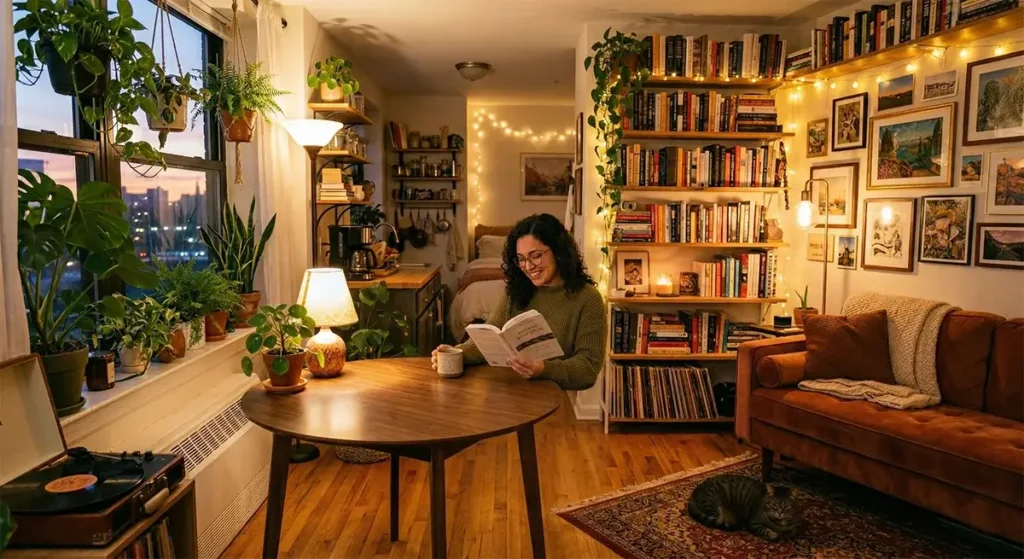
- Make your home actually yours. One of the genuine pleasures of living alone is that every aspect of your living environment reflects your preferences exclusively. Invest in making the space feel genuinely inhabitable and yours.
- Build a “care network” explicitly. Identify 2–3 people who would notice if something was wrong and would check in during illness. Tell them explicitly that they’re part of your support structure.
- Resist the false urgency to change your situation. The question isn’t “when am I going to not live alone?” It’s “is this life working well for me right now?” Treat the answer to that question as the relevant criterion.
The Financial Reality of Living Alone in 2026
One-person households bear all fixed costs on a single income, which in high-cost markets is genuinely challenging. Practical strategies: neighborhoods with lower costs but good transit access; intentional apartment sizing (600–750 sq ft is sufficient and often much cheaper than 900+ sq ft); and building savings aggressively during solo years when lifestyle costs are purely in your control — the financial autonomy of solo living, properly managed, can be a genuine wealth-building period.

Leave a Reply