
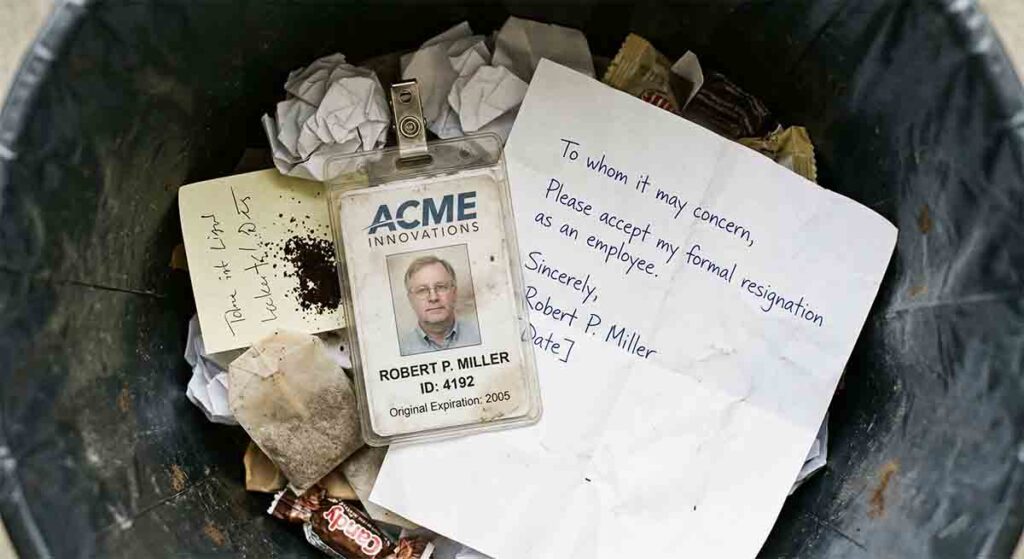
You finally left the job that was making you miserable. You resigned, got laid off, or were finally pushed out of a place that was draining you for years. And now — unexpectedly — you feel something that resembles grief. You miss it. Or you miss something about it. And you can’t explain why, because you hated it.
This is more common than anyone talks about, and it makes complete psychological sense once you understand what work actually means beyond the paycheck.
Work as Identity
In the United States more than almost any other culture, work is identity. “What do you do?” is how we introduce ourselves. It’s how we signal social status, intellectual engagement, and sense of purpose. From early adulthood, we build our self-concept substantially around our professional role — even when that role is unsatisfying.
This means that when work ends — even terrible work — something more than a job ends. A chapter of your identity ends. A way of organizing your time ends. A social world ends. And even when those things were dysfunctional, their loss follows grief patterns.
What You Actually Lost (Even If It Was Terrible)
When people grieve a bad job, they’re rarely grieving the job itself. They’re grieving the specific things that existed within it:
- Routine and structure. Even a hated job provided a framework for time. Without it, days can feel shapeless in ways that feel more destabilizing than expected.
- Social connection. Even difficult colleagues provided daily human contact. Their absence is felt even if the relationships weren’t good.
- Professional identity. Your title, your domain, your expertise as exercised in that specific context — these don’t automatically transfer when you leave.
- The familiar. Even familiar discomfort is predictable. Uncertainty — even the uncertainty of something better — carries its own anxiety.
- The hope that was still alive there. While you were still in the job, change was theoretically possible. Leaving ends that particular version of potential.
The Stages of Post-Job Grief
Post-job grief doesn’t follow the classic five-stage model neatly, but it tends to move through recognizable phases:
- Initial relief — the immediate post-exit period, especially after a difficult departure. This can feel like freedom.
- Disorientation — as structure disappears and identity floats. “Who am I without this role?”
- Unexpected sadness or nostalgia — often triggered by mundane things: passing a former coworker, hearing a company name, checking old work emails.
- Anger and retrospective processing — revisiting what happened, what should have been different, what you wish you’d said or done.
- Integration — the experience becomes part of your story rather than a live wound.
The Paradox of Hating Something You Miss
The confusion of missing something you hated is resolved once you understand that what you miss is not the experience but the certainty. Hating a job is at least a clear orientation — you knew where you stood, what to expect, what role to play. The aftermath of leaving is ambiguous in ways that the mind, which strongly prefers known pain to unknown possibility, experiences as loss.
There’s also an element of sunk cost grief — mourning the years invested in a situation that turned out not to be worth it. That grief is legitimate. It’s grief over lost time, lost opportunity, the version of your career history that might have been if you’d chosen differently or been treated differently.
How to Actually Move Through It
- Name it honestly. “I’m grieving this job” is a more useful frame than “I’m confused about why I’m sad.” Naming it accurately allows you to approach it as a grief process rather than a logic problem.
- Create new structure immediately. The disorientation of unstructured time is often a primary driver of post-job distress. Even artificial structure — a morning routine, regular commitments — significantly reduces this.
- Allow the mixed feelings without resolving them prematurely. You can simultaneously be glad you left and sad about what you left behind. These aren’t contradictions requiring resolution. They’re honest responses to a complex situation.
- Talk to people who’ve done it. The normalization of this experience is powerfully helpful. Most people who’ve made significant job transitions have felt exactly this — they just didn’t talk about it.



Leave a Reply