
You fall asleep fine. You wake up sometime between 2:30 and 3:30 AM and stare at the ceiling. Thoughts arrive. Sometimes they’re anxious. Sometimes they’re just your to-do list. You lie there for an hour, eventually fall back asleep, and the alarm goes off before you’ve gotten enough rest.
This is one of the most commonly reported sleep complaints, and unlike most sleep problems, there’s a clear physiological explanation for why it happens at this specific hour — not at 1 AM or 5 AM, but right around 3.
Sleep Cycles and Why 3AM Is a Transition Point
Human sleep occurs in roughly 90-minute cycles, alternating between non-REM (deep) sleep and REM (dreaming) sleep. The ratio shifts over the course of the night: early sleep is dominated by deep, restorative slow-wave sleep, while later sleep (from about 3 AM onward) is dominated by REM sleep.
This transition — the shift from deep-sleep-dominated cycles to REM-dominated cycles — happens naturally around 3 AM for someone who went to sleep between 10 PM and midnight. At this biological junction, sleep is naturally lighter. If any other factor is present that tips the balance — stress, blood sugar changes, cortisol — you cross the threshold into wakefulness rather than staying asleep.
In other words, 3 AM is a structurally vulnerable moment in the sleep architecture. It doesn’t take much to wake you up at this point, which is why small stressors that wouldn’t wake you at 11 PM bring you fully awake at 3 AM.
The Cortisol Wake-Up Spike
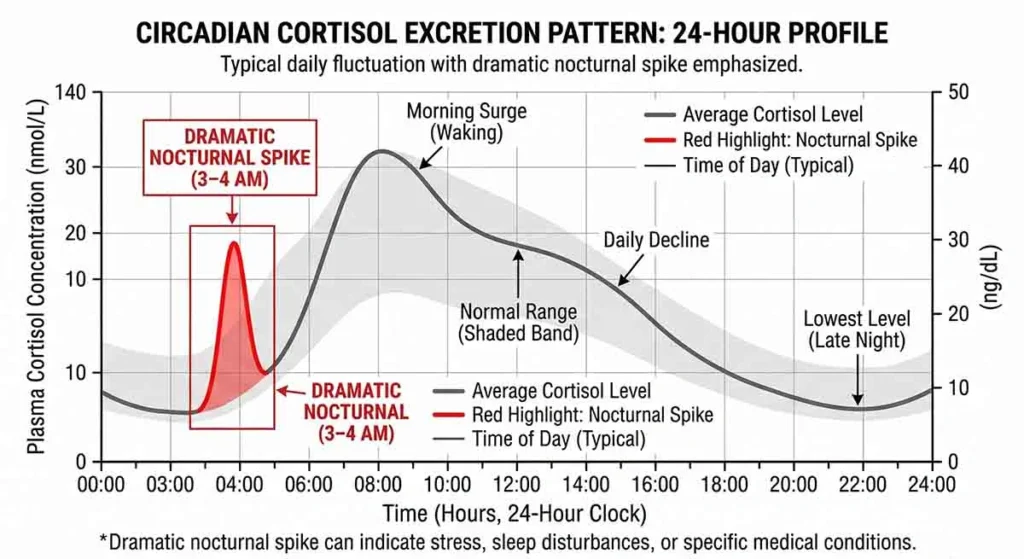
Cortisol — your body’s primary stress and alertness hormone — follows a predictable daily rhythm called the cortisol awakening response (CAR). Levels are lowest around midnight and begin rising in the early morning hours to prepare your body for waking. This rise typically begins around 3–4 AM.
For people under chronic stress, this cortisol rise is both earlier and steeper. The spike that’s meant to gently bring you toward waking instead fires strongly enough to wake you up fully — hours before your alarm, body flooded with alertness hormones, brain interpreting this as a threat response and immediately generating anxious thoughts to explain the physical state.
Blood Sugar and Early Morning Waking
A separate but frequently overlapping mechanism involves blood glucose. If you eat dinner early and have nothing after, blood sugar naturally drops through the night. In the early morning hours, the liver responds to low blood sugar by releasing glucose — but this process can be accompanied by a mild adrenaline response that pulls you into wakefulness.
Signs that this might be your mechanism: you wake up feeling slightly shaky or with a strong appetite; eating a small complex-carbohydrate snack before bed (oatmeal, a banana) reduces wake events; you feel noticeably better after eating in the morning than at other times.
Why Anxiety Peaks at 3AM
The 3 AM anxiety experience is so universal that it has produced its own cultural idiom in multiple languages. The combination of factors that create it:
- The cortisol-driven physical alertness state that the brain interprets as danger
- The absence of distractions that normally keep anxious thoughts from dominance
- The unresolved concerns of the previous day (memory consolidation during REM includes emotional processing, which can surface anxious material)
- The awareness that it’s the middle of the night and you “should” be asleep, which creates secondary anxiety about not sleeping
What Actually Helps
- Reduce chronic stress load. The single most effective intervention for cortisol-driven 3 AM waking is addressing the underlying stress that’s elevating baseline cortisol. This is the unsexy answer, but it’s the true one.
- Don’t look at the clock. Clock-checking activates the anxiety loop about how little time remains before the alarm. Turn clocks away from your bed.
- Don’t fight wakefulness actively. Paradoxical as it sounds, lying in bed trying to force sleep creates arousal. If you’ve been awake for 20 minutes, get up, do something quiet in dim light, and return when sleepy.
- Try a small bedtime snack. If blood sugar is the mechanism, a tablespoon of almond butter or small bowl of oatmeal before bed can prevent the overnight drop.
- Limit alcohol. Alcohol causes a rebound effect around 3–4 hours after consumption that disrupts sleep architecture at exactly the most vulnerable transition point.
- Consider cognitive behavioral therapy for insomnia (CBT-I). The gold-standard clinical intervention for chronic waking, with better long-term outcomes than sleep medication.
Leave a Reply