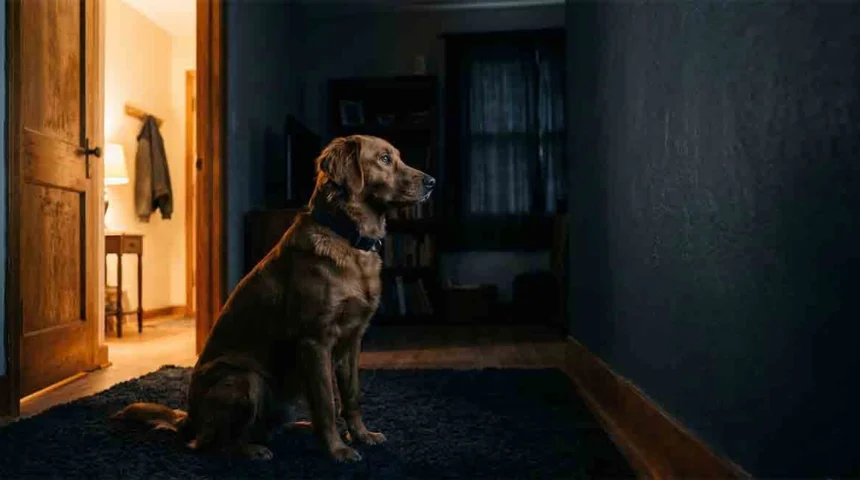
It’s 3 AM. You hear your dog get up. You glance over and there they are, standing completely still, staring fixedly at a blank wall. And then you stare at the wall too. There’s nothing there. Your dog seems completely certain there is.
This behavior unsettles people for obvious reasons. Here’s the honest explanation — which covers multiple different causes, from the mundane to the medical.
What Your Dog Can Detect That You Can’t
Dogs experience the world through a dramatically different sensory profile than humans:
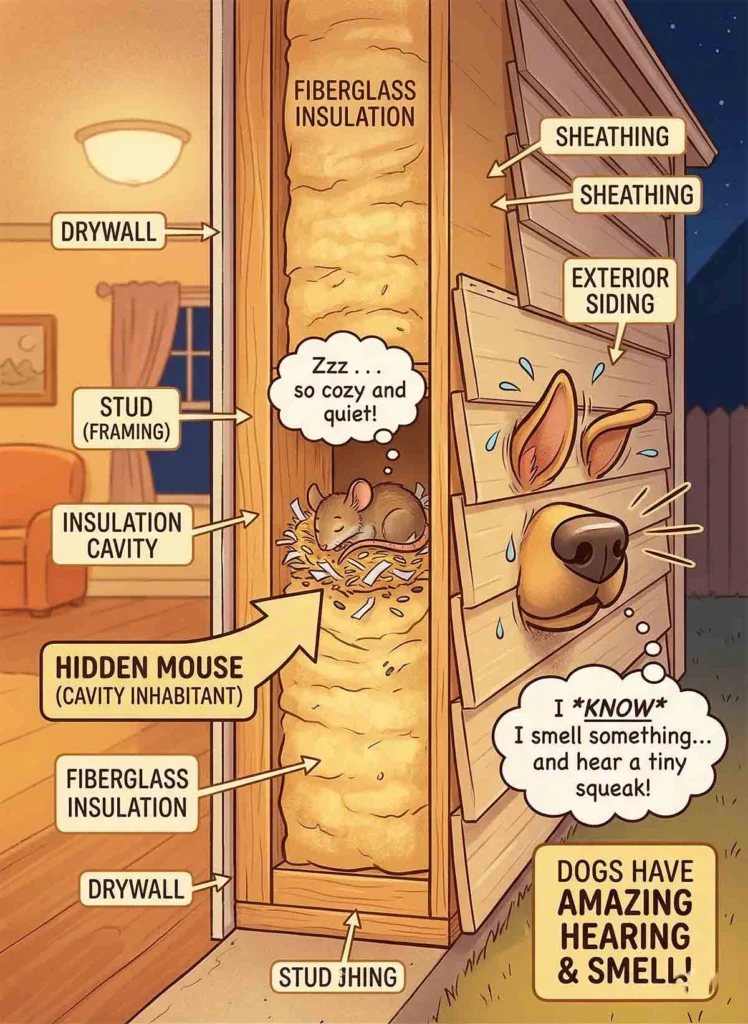
- Hearing: Dogs can hear sounds at frequencies up to 65,000 Hz (humans max at around 20,000 Hz) and can detect sounds at distances four times greater than humans. This means your dog hears things inside your walls, above your ceiling, and outside your building that are entirely inaudible to you.
- Smell: A dog’s sense of smell is estimated to be 10,000 to 100,000 times more sensitive than a human’s. They can detect faint odors — from a mouse, an insect nest, a water leak, a gas trace — through walls and floors.
- Low-frequency vibrations: Dogs are more sensitive to low-frequency rumbles and tremors — including those from nearby infrastructure, HVAC systems, or animal activity — that register below human conscious perception.
In most cases, a dog staring at the wall is responding to something genuinely there — just something you can’t perceive.
The Most Common Cause: Pests in the Walls
The single most common explanation for wall-staring behavior is the presence of animals inside wall cavities. Mice, rats, squirrels, and insects create sounds and odors that dogs can detect easily through drywall. This behavior tends to be more common at night because many of these animals are nocturnal.
Signs that pests are the explanation:
- The staring is always at the same location on the same wall
- Your dog scratches or paws at the wall in addition to staring
- You’ve noticed any other signs of pests (droppings, scratching sounds you can faintly hear, damage)
- The behavior is most intense at night
Medical Causes Worth Taking Seriously
In a minority of cases, unusual staring — especially if combined with other changes in behavior — can indicate a medical issue:
- Partial seizures (focal seizures): Unlike full grand mal seizures, focal seizures can present as brief episodes of unusual behavior, staring, or trance-like states. If your dog’s wall-staring episodes last more than a few minutes, happen repeatedly, or are accompanied by lip-licking, eye twitching, or sudden confusion, focal seizures are worth discussing with a vet.
- Vestibular disease: Affects balance and can cause disorientation, including unusual fixated staring. Usually accompanied by head tilting or stumbling.
- Vision problems: Paradoxically, a dog beginning to lose vision may stare at walls or stationary objects as their visual system tries to process ambiguous inputs.
- Pain: Dogs in localized pain sometimes focus on the area of their body near the wall closest to the pain source — this sounds strange but is occasionally observed behavior.
Canine Cognitive Dysfunction: The Doggy Dementia Explanation
In older dogs (typically 9+ years), wall staring — especially if combined with other behavioral changes — can be an early sign of Canine Cognitive Dysfunction Syndrome (CDS), which is the canine equivalent of dementia. Signs of CDS include:
- Disorientation in familiar environments (including staring at walls)
- Changed sleep cycles — restless at night, lethargic during the day
- Reduced interest in play or interaction
- Apparent forgetting of trained behaviors
- Getting “stuck” in corners or behind furniture
If your dog is older and exhibiting several of these behaviors, a vet assessment is worthwhile. CDS is manageable — medications, environmental modifications, and mental enrichment can significantly improve quality of life.
When to See a Vet
See your vet if: the behavior is new and in an older dog; it’s accompanied by other behavior changes; episodes involve any trance-like state, lip-licking, or physical symptoms; or the behavior is escalating in frequency. If it’s a young, otherwise healthy dog staring at walls at 3 AM — you almost certainly have mice.
Leave a Reply