
It’s Saturday morning. You have nowhere to be. You sit down on the couch with a cup of coffee and — almost immediately — a low hum of guilt starts. You should be doing something. Sound familiar?
If resting makes you feel lazy, unproductive, or vaguely ashamed, you’re not broken — you’re experiencing one of the most common and least discussed psychological conflicts in modern American life. Let’s get into exactly why this happens and how to stop it from ruining your days off.
Why Rest Guilt Happens
Rest guilt has a formal psychological basis. It’s rooted in a cognitive pattern called achievement-contingent self-worth — where your sense of value as a person is tied directly to how productive you are. When you stop being productive, even briefly, your self-worth takes a perceived hit, and your brain registers this as a mild threat.
That “threat” response produces discomfort — which your brain interprets as guilt. You haven’t done anything wrong. You’ve simply stopped accumulating proof of your worth for a few hours, and your conditioned mind doesn’t know what to do with that.
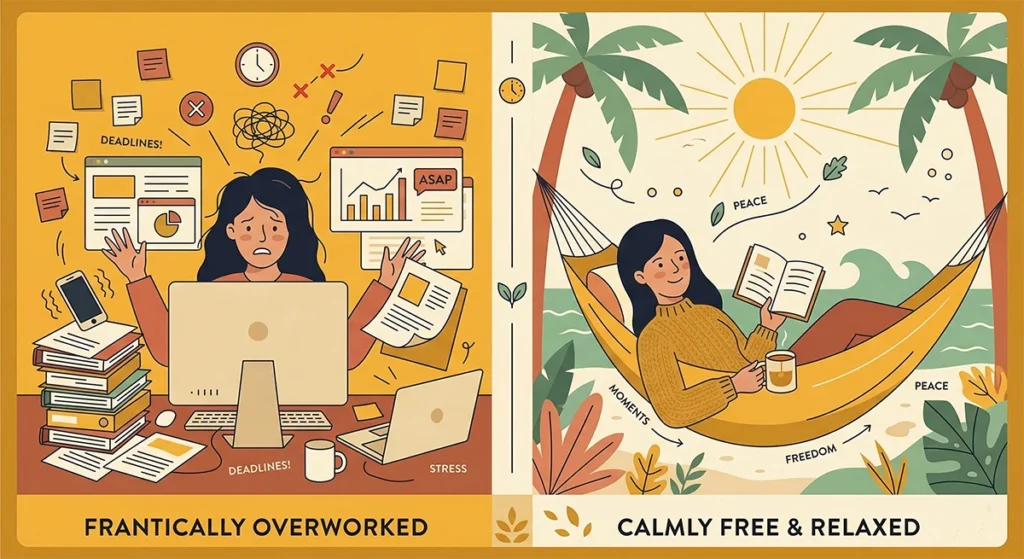
The Role of Hustle Culture — and Something Older
Social media made this worse, but it didn’t invent it. The roots go back centuries to the Protestant work ethic — a cultural belief, especially strong in America, that hard work equals moral virtue. If you’re working hard, you’re a good person. If you’re resting, you’re wasting God-given time.
That belief got secularized and amplified. Today it looks like LinkedIn posts about 5 AM routines, Twitter threads about how successful people “don’t take days off,” and a social environment where asking someone “what are you working on?” is a greeting, not a question.
The result: millions of Americans who cannot sit still on a Sunday without an internal monologue telling them they’re falling behind. The people who seem immune to this typically either grew up in households where rest was modeled as normal, or they’ve done the deliberate cognitive work to rewire it.
What Your Body Is Actually Doing When You Rest
Here’s the scientific argument for rest that your guilt-brain conveniently ignores:
- Memory consolidation happens during rest. Your brain processes and organizes information from the week during downtime — not during work.
- Creativity requires default-mode network activation. The brain’s “default mode” — active when you’re not focused on tasks — is where novel connections form. Hustle shuts this off.
- Cortisol recovery requires actual downtime. Chronic low-level stress (which most working Americans experience) suppresses immune function, disrupts sleep, and raises cardiovascular risk. Rest is not optional maintenance — it’s required recovery.
- Decision fatigue is real. The more decisions you make without rest, the worse those decisions get. The brain’s prefrontal cortex — responsible for judgment — genuinely degrades in quality without adequate recovery.
Resting isn’t avoiding productivity. It’s the prerequisite for it. The highest-performing people in any field — athletes, surgeons, executives — have structured recovery built into their schedules because rest is when adaptation and consolidation occur.
Productive Rest vs. Laziness — Is There Actually a Difference?
This is the question rest-guilt loves to ask as a trap. “Am I resting, or am I just being lazy?”
The distinction matters less than your brain insists. Here’s a more useful framework: Is this rest voluntary and temporary, or is it avoidance of something you need to face?
Resting on Saturday after a full work week is recovery. Avoiding a difficult conversation for three months while watching Netflix is avoidance. The activities can look identical from the outside. The difference is internal — whether the rest is chosen and temporary, or whether it’s being used to escape something you’re afraid to confront.
If you’re genuinely recovering? There is no guilt-worthy laziness happening. You’re doing exactly what a functioning human being should do.
How to Actually Unlearn Rest Guilt
This takes time, but it works:
- Schedule rest explicitly. The same way you block time for work, block it for rest. Calling it “scheduled recovery” instead of “doing nothing” genuinely helps your brain accept it.
- Notice the thought, don’t fight it. When the guilt voice shows up, say internally: “There’s that guilt voice again.” Naming it creates distance. Arguing with it gives it power.
- Track what rest actually produces. After a day of real rest, pay attention to how you feel Monday. Most people notice measurable improvements in mood, focus, and patience. This builds evidence against the guilt narrative.
- Audit your information diet. If your feeds are full of hustle content, rest guilt has a constant supply of ammunition. Unfollow accordingly.
- Get comfortable with the discomfort. Rest guilt usually peaks in the first 30 minutes of rest and then fades. If you can push through the initial discomfort without picking up your phone or starting a task, your nervous system learns that stillness is safe.
“You are not a machine. You do not become more valuable by running at full capacity indefinitely. Rest is not the opposite of productivity — it is the foundation of it.”
The next time you sit down on a weekend and feel the guilt creeping in, remember: what you’re feeling is not an accurate signal about your worth as a person. It’s an old, overlearned rule that was never based on evidence. You have full permission to ignore it.



Leave a Reply